


Surgical techniques chosen
with safety and recovery in mind
Based on experience with a wide range of cases and current surgical techniques, our Surgery Center plans each operation with a focus on safe surgery, a better prognosis and a faster recovery.
-
01Total Hip Replacement
THR
(Total Hip Replacement)01THR (Total Hip Replacement)
Artificial hip jointWhat is total hip replacement?
Total hip replacement (THR) was developed as an alternative to femoral head and neck ostectomy (FHNO) for hip disease. After THR, dogs can usually walk and run normally, with little or no pain, for a relatively long time. It is also a demanding operation that requires precision and experience, so it is best performed at a hospital with a dedicated surgical team.
THR at S
-

A dedicated THR team
THR is performed by an experienced team, led by a surgeon trained in THR by both BioMedtrix (USA) and BlueSAO & Vetmaster (China). -

First in Korea: THR for small dogs
THR used to be possible only for large dogs over 20 kg. After researching the technique, we became the first in Korea to apply cementless dual-mobility THR to small-breed dogs, so small dogs with hip disease can also have THR, with the aim of normal walking and pain relief. -

Equipment & sterile system
Our hospitals are equipped for examination, treatment and surgery, with a sterile operating system.
-
-
023D Printing-Assisted Orthopedic Correction Surgery
3D-Printing-Assisted Correction
023D-Printing-Assisted Orthopedic Correction
Patient-specific surgical guidesWhat is 3D-printing-assisted correction surgery?
We use 3D printing in angular correction and fixation surgery to improve accuracy and shorten operating time.
-

Precise surgical planning
3D printing lets us plan the operation precisely before it begins. -

Custom guides
We make a guide for each patient with CustoMedi 3D-printed guides, licensed as veterinary medical devices, which can improve the chance of success. -

More efficient surgery
Greater accuracy and shorter operating time help the patient recover faster.
Each 3D-printed guide is built from the patient's own anatomy and pre-operative CT or MRI scans, so treatment is tailored precisely to the individual animal.
Surgical planning video, and before and after correction
-
3D-printed surgical planning
-
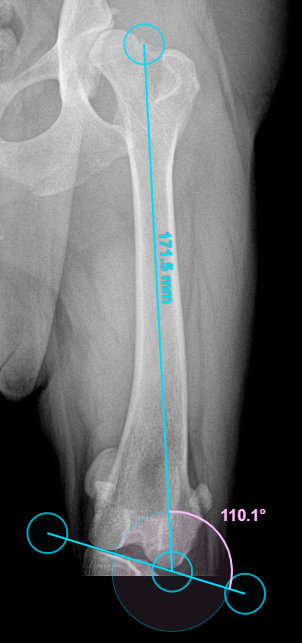 Before correction
-
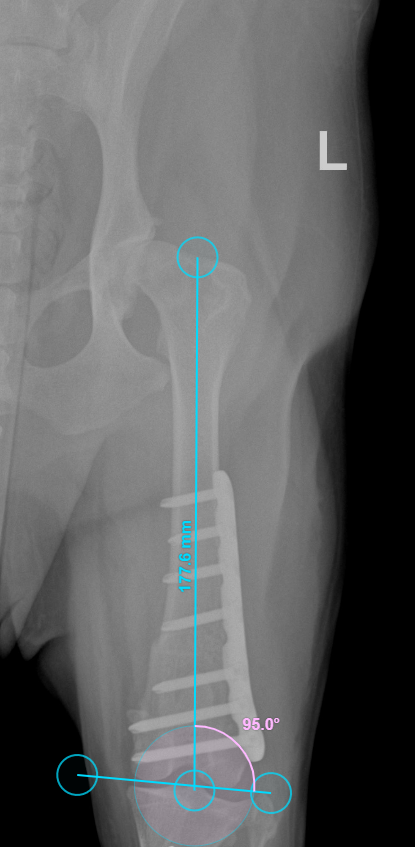 After correction
-
-
03Minimally Invasive Surgery
Minimally Invasive Surgery
03Minimally Invasive Surgery
Endoscopic & laparoscopic proceduresWhat is minimally invasive surgery?
Minimally invasive surgery uses endoscopic instruments with a tiny camera — arthroscope, laparoscope, cystoscope, rhinoscope — to see and treat the lesion directly through an incision of just 0.5–1 cm.
Our Surgery Center uses minimally invasive techniques for joint, nasal and bladder disease and more — and, depending on the patient, can diagnose and treat in a single procedure.
- Arthroscopy: cruciate ligament disease, shoulder joint disease
- Rhinoscopy: chronic nasal discharge, nosebleeds, examination and biopsy of suspected nasal tumors
- Cystoscopy: bladder stone removal, investigating blood in the urine, bladder tumor biopsy
- Laparoscopy: spay/neuter and other procedures
* The minimally invasive procedures available may differ between our Ulsan and Yangsan hospitals, so please check with us first.-

Minimal incision
An incision of just 0.5–1 cm instead of opening up the whole surgical site. -

High accuracy
The endoscope shows the affected area clearly while the surgeon operates. -

Less pain after surgery
A minimal incision usually means a faster recovery and less pain than conventional surgery. -

Diagnosis and treatment together
With the endoscope, diagnosis and treatment can happen in a single procedure.
-
04Tibial Plateau Leveling Osteotomy
TPLO
(cruciate ligament surgery)04TPLO (cruciate ligament surgery)
Tibial Plateau Leveling OsteotomyWhat is TPLO cruciate ligament surgery?
Corrective techniques for cruciate ligament rupture include TPLO, TWO, TTA and CBLO; TPLO, TWO and TTA are the most common. At S we choose the technique that suits the patient's age, weight and symptoms, and where possible prefer TPLO for its post-operative stability and success rate.
-

Stability and fast recovery
TPLO avoids the shortened tibia seen with TWO and the extra strain on the patellar ligament seen with TTA. It is a precise technique, generally associated with fast recovery and a good prognosis. -

Gold Standard
In countries with advanced veterinary care, TPLO is the most widely performed cruciate ligament surgery and is widely regarded as the gold standard.
Comparing techniques
-
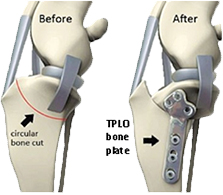 TPLO
-
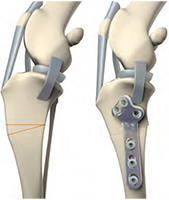 TWO
-
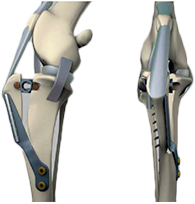 TTA
Image source: mydogsymptoms.com/tibial-tuberosity-advancement -

